When you think of chewing tobacco today, if you do at all, you might picture Red Man (now politely called America’s Best) or Beech Nut, loose-leaf tobacco pieces in a foil-lined pouch. When I was a kid in the 1980s, every local baseball field was littered with black wads of the stuff, spit out by umpires and coaches as the kids chewed their Bazooka Joe or Double Bubble.
In 1880, when C.A. Raine & Co. was just getting started, 58% of the tobacco consumed in the United States was for chewing, 19 % for smoking and cigarettes comprised less than 1%. Two kinds of chewing tobacco the company made, twist and plug, are unfamiliar to most Americans today..
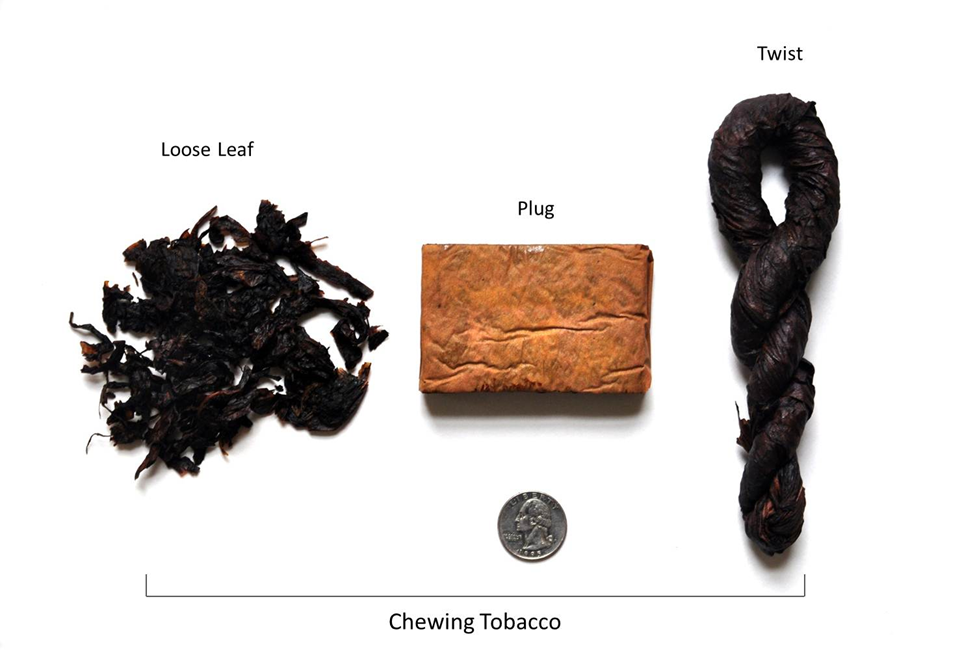
Twist tobacco was an early American staple but is now very difficult to find. You may see it in the hands of a Civil War reenactor but rarely in a physical store. It consists of cured and stemmed tobacco leaves, dampened, and twisted tightly into a rope, then doubled back onto itself. A piece would have been cut off from the twist and either chewed or smoked in a pipe. Twist was portable and durable but likely strong tasting unless treated with flavoring. Before modern medicine, this kind of tobacco was fed to cattle occasionally as a de-wormer.
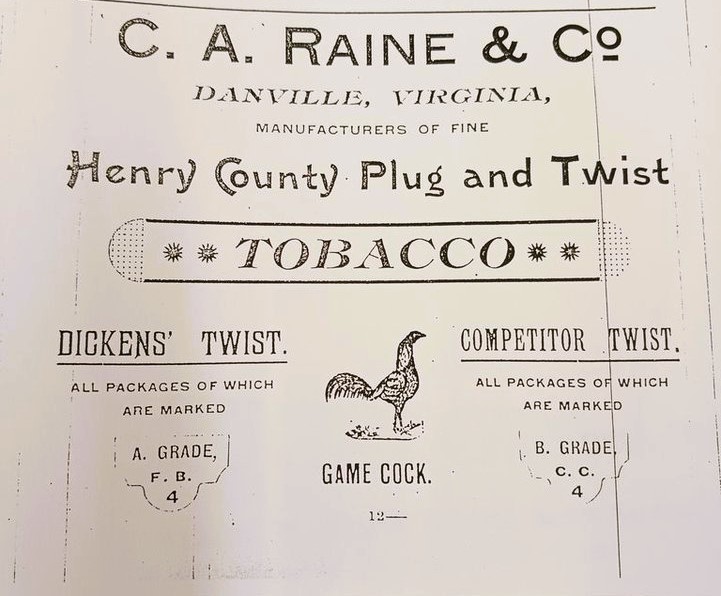
C.A. Raine & Co. produced several brands of twist tobacco including Dickens’ Twist and Competitor Twist according to an advertisement in the 1892 Connorton’s Tobacco Brand Directory.
In Charles Anderson Raine’s day, plug was the most commonly-used type of tobacco and it was certainly his most important product which he sold under many brand names. Plug is hard to find now but it is still manufactured in small quantities. It comes in small squares about 3 inches wide and 4 inches long or so, looking not unlike a piece of a brownie.
It is made with cured and stemmed leaf which is boiled in a mixture of flavoring and sweetener. Next, the leaf is dried and compressed under high pressure to form squares. Most Danville manufacturers encased the final plug in a golden “wrapper” of a single leaf of high-grade, bright leaf tobacco.
The chewer carves off a small piece and places it between the cheek and gum, chewing as needed. Plug is so highly compressed that a little goes a long way. It could also be placed in a pipe and smoked but plug for chewing and smoking are two different products today.
Unusable, leftover pieces of tobacco from the plug manufacturing process were sold as scrap chewing tobacco. Scrap tobacco or loose leaf tobacco, like Beech Nut and America’s Best (Red Man), is what largely replaced plug in the 20th century. Baseball authorities discourage tobacco use on the field and in the stands today, but alternatives, whether it be gum or unshelled sunflower seeds, remain.
Sources:
Graves, John. “Chew Road to Knowledge,” Texas Monthly. Nov. 1978. Link
Tate, Cassandra. Cigarette Wars: The Triumph of “The Little White Slaver.” Oxford University Press. 1999.
Tilley, Nannie, M. The R. J. Reynolds Tobacco Company. UNC Press. 1985
 C.A. Raine & Co.