“…J. M. Brower started me in the manufacturing of tobacco, giving me 1/3 net profit, the firm being C. A. Raine & Co. We continued business under many difficulties and without success until 1878, when Mr. Brower sold out lock, stock, and barrel.”
-From Charles Anderson Raine’s Autobiography
In his autobiography, Charles Anderson Raine makes two fleeting mentions of a man named J.M.. Brower. He was Raine’s employer for a short while and “started” him in the tobacco business. Who was this man who is mentioned briefly but had an outsized role in the formation C.A. Raine & Co.?
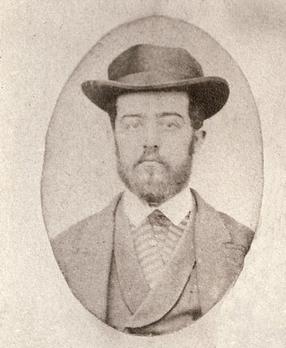
J.M. Brower circa 1870.
Charles Anderson Raine, 14, was devastated when his mother died in 1855. Soon after, the family was scattered. Charles left school and got a job as a clerk for a railroad contractor in what is now West Virginia. His little sisters were sent to live with an aunt in North Carolina. In a way, this tragedy provided the opportunity Charles needed to start in the tobacco business years later.
Census records show that in 1860 Charles’ sisters, Nannie M. Raine, 13, and Bettie Raine, 9, were living with Sallie N. Smallwood, their maternal aunt on a farm in northern Rockingham County, North Carolina, near the Virginia state line. Sallie is listed as the head of household; she was likely a widow. At this point, the two girls may have already lived with their aunt for several years.
In his autobiography, Charles writes about visiting his aunt and beloved teenage sisters in North Carolina while on furlough from the Confederate army in 1863 and in the summer of 1865 after the war ended.
In 1867, Nannie Raine, then 19 years old, married John Morehead (J.M.) Brower in Rockingham County. The Brower family operated a store there. J.M’s father Jacob W. Brower founded a large retail and manufacturing operation about 60 miles to the west in Mt. Airy, Surry County, North Carolina, on the state line with Virginia.
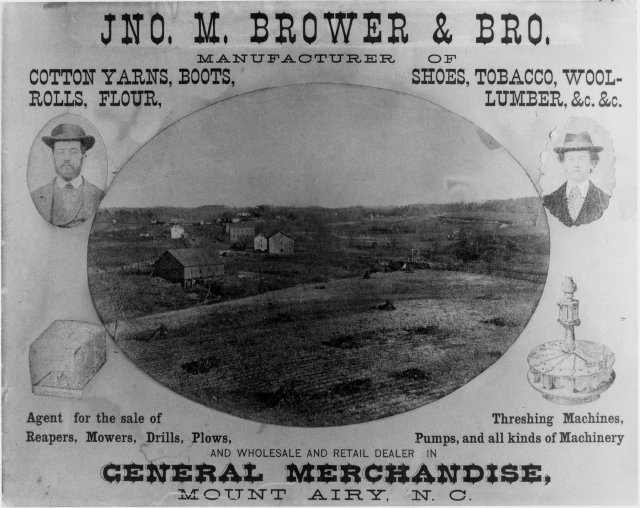
The 1880 industrial census lists the Browers as owning two grist and flour mills, a shoe factory and tannery, a cotton mill, a wool mill, and a saw mill, all located on and powered by the Ararat River. The Browers were a wealthy and influential family in that part of North Carolina. Jacob Brower died in 1868, the year after J.M. and Nannie married. Control of the family businesses, now styled J.M Brower & Bro., passed to J.M. and his brother.
Advertisement for J.M. Brower & Bro. circa the 1870s.The text shows the diversity of business interests in which the Brower brothers were involved. J.M. Brower is on the left. The image in the middle shows the various factory buildings along the Ararat River. Image: Courtesy of Surry County Historical Society.
The first time that Charles Anderson Raine and J.M. Brower crossed paths in a business sense was in 1871 when, after giving up on farming for his father-in-law, Charles moved to Mt. Airy to work for J.M. Brower & Bro. as a store clerk for $50 a month, eventually bringing his wife Bettie with him.
Charles left for a new start in Danville after a year or less but it was J.M. Brower who bankrolled Charles’ first foray into the tobacco business three years later in 1874. The venture was unsuccessful and Brower sold his interest four years later in 1878. Likely, the challenges of that first run at tobacco manufacturing taught Charles many valuable lessons.
So, the mystery of J.M. Brower or Mr. Brower from the autobiography is solved. He was Charles Anderson Raine’s brother-in-law. Perhaps the relationship is not mentioned in the autobiography because C.A. Raine’s children, his audience, already knew Brower as their uncle. Regardless, the story of J.M. Brower doesn’t end there.
J.M. Brower was an ambitious man and quickly turned to politics after the Civil War aligning with the Republican party. Until large-scale suppression of African American voting rights after 1900, the Republican party was a powerful force in North Carolina; it depended on a coalition of Blacks and Whites to wield power and most white Republican voters came from the piedmont and western portions of the state.
Brower won an election to the North Carolina state senate (1876-1878) and then was elected twice to the U.S. House of Representatives (1887-1891). In 1889 he made a play to become the Speaker of the House according to the Statesville (NC) Record and Landmark newspaper but was unsuccessful. After leaving Washington D.C., he was elected to a single term in the North Carolina House of Representatives (1896-1898).
J.M. Brower was held in high regard in Mt. Airy and Surry County but he, and most white Republicans, was hated with a passion by Democrats in the state. North Carolina newspapers of the time, especially those in the eastern half of the state, portrayed Brower as a traitor and used racist language to describe him and his constituents. It is likely that he and his family were in personal danger at times.
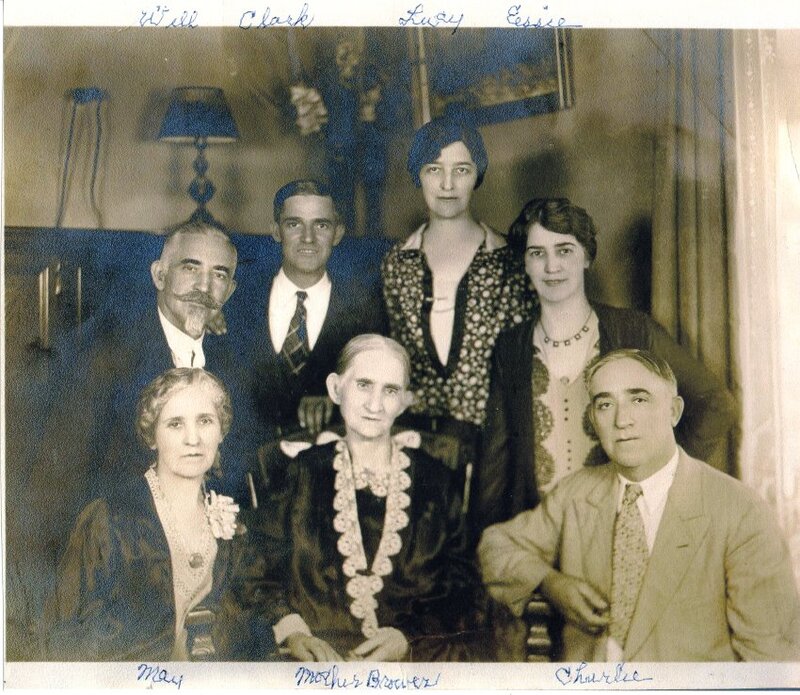
In 1907, Brower left North Carolina with his family to farm and started new businesses in Boswell, Choctaw County, Oklahoma. In the 1910 census his occupation is listed as “private income.” He died in 1913 and was buried in Mt. Airy. Two of his sons remained and settled in Texas, another joined government service abroad. The rest of the family relocated to Mt. Airy. Nannie Raine Brower lived with two of her daughters and died of senility and myocarditis on March 27, 1938, at the age of 90.
Photograph of the Brower family children with their mother Nannie Raine Brower, Charles Anderson Raine’s sister, Front row from left May Brower, Nannie Raine Brower, Charlie Brower. Second from from left William Brower, Clark Brower, Lucy B. Cook, and Essie B. Fawcett. Photograph is undated but is likley circa 1920s. Image: Courtesy of Surry County Historical Society.
Sources:
1860 U.S. Census, Northern Division, Rockingham County, North Carolina, population schedule, Wentworth post office, p. 32, dwelling 229, family 224.
1880 U.S. Census, Mt. Airy, Surrey County, North Carolina, industrial schedule, Mt. Airy post office, p. 1.
1910 U.S. Census, Hunter Township, Choctaw County, Oklahoma, population schedule, Boswell, p. 20.
This autobiography is an absolute gift to C.A. Raine’s descendants. –Dale
Charles Anderson Raine (28 Jun 1841 – 4 Mar 1902) written in Danville, Va., 11 Feb. 1897.
I am fifty five and a half years old – my physical strength is almost wasted – but all the faculties of my mind are as strong as they have ever been. I cannot look forward to prospects to brighten and gladden my dreams of the future. I live in the past, that past which “time shall know me more forever”. In this frame of mind and body I begin a sketch of my life. My children ask it and I can leave them no other heritage.
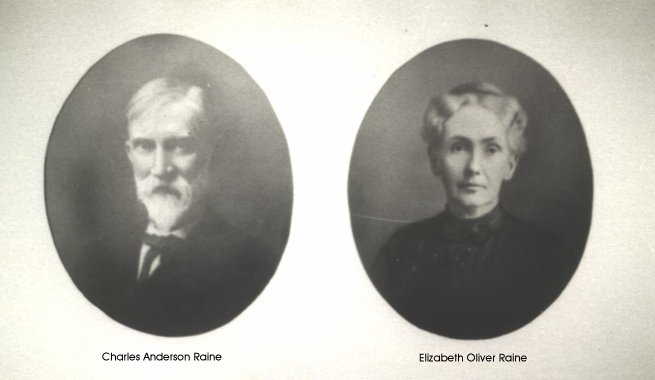
Side-by-side photoraphs of C.A. Raine and Betty C. Raine. Image: Syd Dickenson’s Raine Family Website.
Early Education
I attended only the schools that were common in those days from ’48 to ’59. Hence mine was a limited education. My first teacher was an old Baptist minister, the Rev. John T. Watkins, who also taught my father before me. My progress was rapid for one so young but I loved my books taught me by this good old man which accounts for the rapid strides, as I may term it, I made in my studies. Mr. Creed Taylor was also one of my teachers sometimes in the fifties.
But the most unsatisfactory instruction I ever received in my whole experience at school was that given me by an Irishman named McGowan in 1852 or 1853. If there could be such a thing as unlearning what had been previously gained I have this consolation about it, McGowan most successfully accomplished this end. My fear of the man was such that the very sight of him in the schoolroom struck me with terror and right here I would remind the readers of this sketch that too much importance cannot be put upon the easy relation between pupils and teachers.
Death of Bettie Venable Michaux
In 1855 my father sent me to school to Mr. Jack Berryman, Oak Forest, Cumberland Co., VA. I boarded with Mr. Burley Trent. This proved a most sad and unfortunate step. In a very short while, in about one week after beginning school to Mr. Berryman, I was stricken down with Typhoid Pneumonia in the severest form and lay with life almost extinct for a week or ten days. My mother hearing of my extreme illness at once came to my bedside. It was bitter cold and the trip by private conveyance caused her to contract Pneumonia and leaving me somewhat improved returned home and died in three days, February 12th, 1855.
In the meantime, I was taken with a relapse caused by getting out of bed, dressing and watching for my mother’s return, and in April the sad intelligence of my dear mother’s death was communicated to me. I had then recovered sufficiently to return home and my friends endeavored to prepare me for the sorrow and desolation awaiting me at the once happy home of my childhood. My mother was gone, misfortune had overtaken my poor father and he had to bear not only the loss of his wife but also the sale of his property to satisfy creditors, and I found him struggling under this weight of cares and trials. The family had been broken up, never again to be united on this earth.
My two sisters, Nannie and Bettie, had been taken to the home of my maternal aunt, Mrs. S. W. Smallwood, Leaksville, NC. Ah! The anguish of those unhappy hours! I had never felt the need of anything. But I prayed and God heard me. Besides the last words of my mother, I was told, were a prayer in my behalf.
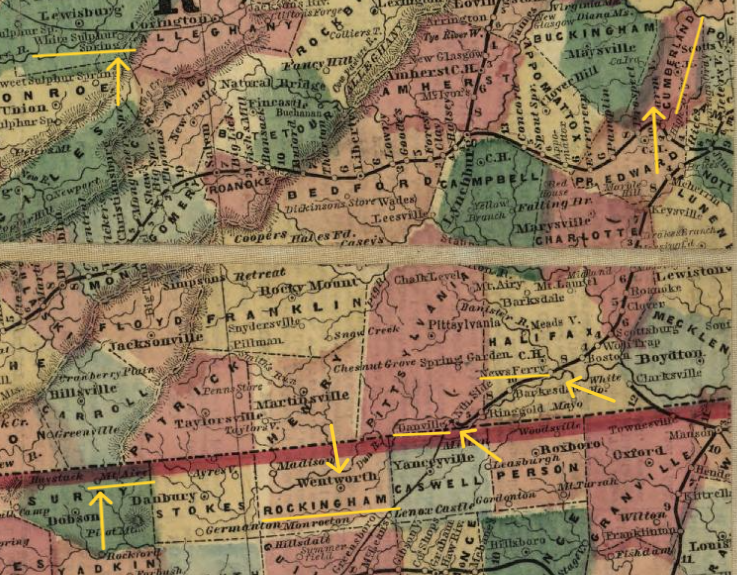
Places that figure prominently in C.A. Raine’s story are (clockwise from top left) White Sulphur Springs, Va., Cumberland County, Va., News Ferry, Va., Danville, Va., Rockingham County, N.C., and Mt. Airy, N.C. Image: Library of Congress, Lloyd’s Map of the Southern States. Public Domain.
Bad Times
I felt the necessity of personal exertion and in 1857 secured employment with Frank Lear, R. R. Contractor, C&P R.R. near White Sulphur Springs, as clerk in commissary. My life in the mountains was a wild and reckless one, and many incidents that can now be recalled impress me with pain and regret. In fact, could I but recall and blot out a few pages of my past history, I would feel an inexpressible degree of comfort and satisfaction. But the seeds have been sown. I can’t atone for those sins, but “If thou shalt confess with thy mouth the Lord Jesus and believe in they heart that God hath raised Him from the dead thou shalt be saved” through faith in Him.
On returning from the mountains in Allegheny Co., I began school again in 1858 to Mr. H. E. Jennings and boarded with Mr. William Holman. In 1859 I left school not knowing where to go nor what to do. I had no means but in some way managed to drift into Rockingham Co., N.C. at the home of the aunt before mentioned. Here I remained a few months and then went to live in Patrick Co. with Zentmeyer Penn Co., Merchants, at Mayo Forge.
Dogs of War
In 1860, August 1st, I went to News Ferry, VA as bookkeeper for Mr. Thomas Chalmers where I remained until the dogs of war were let loose and the whole country from Maine to California was aroused to such a degree of excitement that it was in no way safe for a northern man to enter the South and vice versa.
I had no cares, no sweetheart, no nothing and no one seemed to care for me. My loss would have been felt only as one less in the ranks. I had drifted for six years along the rugged edges of the world’s unfriendly shores without the tender loving care of a mother and without the admonition and warning of a father. I knew little about the great questions that were agitating the country. I only felt that persuasion was better than coercion. I could not see that one section of our country under the laws of our Federal system had the right to force into subjection not a seceding state but states. I could not reconcile it to my mind to join and army of invasion and subjugation. Our ancestors had given their lifeblood for the great boon of freedom.
Enlistment in the War
When a call of troops was made upon Virginia all the patriotism of my boy life was aroused. In April 1861 I joined the Brooklyn Grays under Capt. Wm. Haymes. And in May 1861 my company was mustered into the service of Virginia and was a part of the 23rd Virginia Regiment, Company E, Colonel W. B. Taliaferro commanding.
Col. William B. Taliaferro circa 1865. Courtesy Virginia Military Institute Digital Archive.
Early in June our Regiment was sent to West Virginia, Randolph County, and took position at Laurel Hill with other troops under command of Gen. Garnett. Our march from Stanton over the old Parkersburg Turnpike – about 100 miles – was indeed trying. I had never been accustomed to exposure; consequently, the hot June sun, long daily marches and our rest at night upon another earth with only the broad canopy of Heaven above us for shelter, no wonder we fatigued and tired.
After several days we reached our destination and were soon confronted by Generals McClelland and Rosencranz with superior numbers, and after some skirmishing with the enemy we were forced to retreat. Not, however, until we had demonstrated to him that we were “a foe worthy of his steel.”
On one particular occasion while on the line of skirmishers I was suddenly confronted by a blue coat less than 100 yds. off and with all the quickness I was able to act I fired upon him, disabling or killing him, thereby saving my own carcass, as he was at that instant preparing to shoot me.
Loss of General Garnett
We retreated hastily from our position, the enemy having, by maneuvering, gotten into our rear. Having eluded him at Beverly we were vigorously pursued and were compelled to stop and give battle at Carracks Ford (Cheat River). Our Regiment being the rear-guard being only engaged. It lasted fifty-five minutes and was decisive in the fact that we were not pursued further. In this fight General Garnett was killed besides losing a wagon train and one piece of artillery with several prisoners. Our retreat was continued, without other engagements or incidents of interest except hardships and suffering growing out of hunger and long forced marches to Monterey and McDowell in Highland County, where relief in troops and supplies met us.
Remaining at Monterey a few weeks recovering in strength from the severe hardships we had undergone and getting supplies of clothing and provisions, our command was removed to Greenbrier River in Pocahontas Co. where we entrenched ourselves to await the advance of the enemy from Cheat Mountain. General Henry R. Jackson of Georgia commanded our forces – composed of Col. Ruck, 3rd Arkansas; Col. Ed Johnston, 12th GA; Col. Fulkerson, 37th VA; and Col. W. B. Taliferro, 23rd VA. With our command this campaign was an uneventful one except in one instance the enemy advanced upon us but alarmed, or from some other cause, did not come within our reach, and after parading in our view a short time with a feint to attack us on the right flank – like the French General in the story “marched back again” to his position.
Jackson’s Foot Cavalry
Early in November 1861 we broke camp and marched to Winchester, VA under General T. J. Jackson and were the 3rd Brigade of Jackson’s, famous for the grand achievements made by this great General from the winter campaign of January, 1862. Kerns town battle Mch. ’62 then up the valley to McDowell defeating Milroy and back again down the valley routing and ruining Banks at Strasburg, Front Royal, Winchester, pursuing him to Harper’s Ferry, then back again up the valley pursued by Fremont northwest and Shields-east, a sort of flank pursuit by Shields until Port Republic was reached where both were dealt with by this staid hero in detail – defeating both Generals, capturing many prisoners, several pieces of artillery and a quantity of small arms. The quickness and effectiveness of these movements won for General Jackson’s troops engaged in this campaign (beside additional glory to his greatness) the name of “Jackson’s Foot Cavalry” by which they were called ever afterwards.
The valley campaign of 1862 ended, General Jackson joined General Lee after hard and forced marches in time to engage in the historical seven days fight around Richmond. No reader of history can form an idea of the endurance of Jackson’s men. Inured to hardships, fatigue and hunger as well as the dangers of the battlefield – well indeed may they be termed veterans. No undertaking was too difficult for them, as they would say, “if old Jack ordered it.” The love for and confidence in their leader was grand and beautiful and as General Lee said “If Jackson had been at Gettysburg the result would have been different.”
After the smoke of battle had cleared away and the Confederate Capital relieved of its threatened fall, the first Maryland campaign was begun. General Jackson met General Pope in Culpeper at Cedar Mountain August 9, 1862, and after a hard fought battle (at one time almost a defeat to us) gained the fold and captured many prisoners. An incident occurred here which I will relate.
Capturing the Enemy
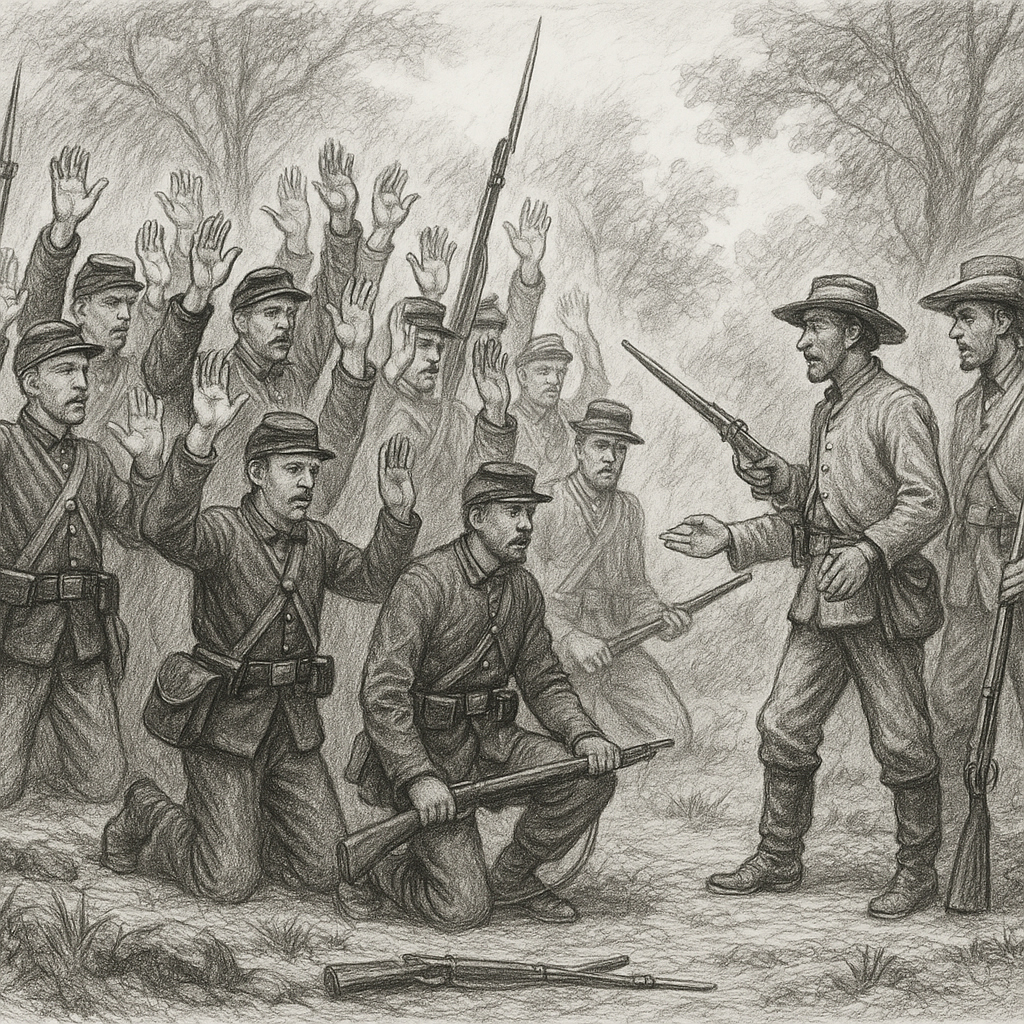
The fight here was carried on until after the shadows of night (almost 9 o’clock). In the confusion and disorder of troops – during and after battle – my Company (I was 1st Lieutenant in command) was scattered and I could find only two of my men, Asa and George Green, brothers from Halifax County. We continued pursuing the broken ranks of the enemy, as we thought, when very suddenly in our rear a body of men was coming after us. It was too dark to see and distinguish the color of their uniform, and we were for a time in a sort of a dilemma. But halting, and putting on a fearless front I commanded in a loud voice “Halt!” No sooner commanded than obeyed and after the usual parlay an officer came forward and surrendered to me his side arms – a handsome sword and pistol – after which I ordered his men to lay down their arms and advance which they too promptly obeyed. Their surprise and chagrin can better be imagined than described when I ordered my command of two men to arise (they were lying down in the woods where thy had been clicking their gun locks to deceive them as to our number during the parlay with the officer not twenty steps off) and they saw that they – a Capt. J. A. Smith, Boston, MA with thirteen men had surrendered to a Confederate Lieutenant and two privates. The Captain asked, “Are these all the men you have?” to which a reply was evaded until we were safe within our own lines. It was a narrow escape for us.
A recreation of the surrender of Union soldiers as described by C.A. Raine. Image: Chat GPT.
The darkness having confused us, we had gone too much to the right of our line and found ourselves in short distance from a part of an unbroken line of the enemy reserves. Placing our prisoners with others under a detailed guard, we changed our direction and soon joined our command.
Four Weeks Out of Action
After the Battle of Cedar Mountain I was taken sick and remained in Field Hospital for several weeks near Gordonsville or Orange Court House and did not engage in any part of the campaign that year, escaping 2nd Manassas, Sharpsburg, Harper’s Ferry, etc. I rejoined the army in September after it had recrossed the Potomac and participated in the Battle of Fredericksburg on December 13, 1862. After Fredericksburg we went into winter quarters near Skenker’s Neck on the Rappahannock. Here I fattened and developed into a stout man weighing 175 pounds. My improvement in great measure was attributable to the oysters and fish issued to us gotten from the Rappahannock. We went into the Chancellorsville battle after our long winter’s rest May 3, 1863 full of enthusiasm and confidence.
Death of Stonewall Jackson
The result of that memorable fight is well known. Besides the loss of General Jackson our death list was a long one comprising many of our best subordinate officers and soldiers. The death here of our Adj. Howard Dupuy made his position vacant, to which I was commissioned by Secretary of War Mr. Seddon a short time afterwards. I continued to fill the duties of this office to the end.
Gettysburg
After some time of recuperation General Lee began his Pennsylvania Campaign and fought the battle of Gettysburg – the Waterloo of the Confederacy -July 1, 2 and 3, 1863. In this engagement our Brigadier General George H. Stewart, General commanding, was on the extreme left of our line, and our Regiment as it happened was on the extreme left of the Brigade. In the charge on Culp’s Hill the approach to the enemy’s works was impassable on account of the natural location of the position – with precipices in the entire front except that part of the line immediately before us and further to our left.
We gained the enemy’s breastworks and poured our fire up the enemy’s line to our right thus relieving our men of the other Regiments of the Brigade to our right from the murderous fire they were receiving, pressed as they were in a cave under a strong crossfire of the enemy. Here it was, that while considered by my Col. S. T. Walton a very heroic, brave and daring act was nevertheless a very imprudent one.
Volunteer at Gettysburg
When we gained the earthworks we discovered by the flashes of the guns (it was dark) that these troops were firing in the direction we had come from. The Colonel was puzzled and ordered his men to cease firing and asked for a volunteer to ascertain and report what troops these were. I offered my services and went forward between the two lines to within pistol shot – 20 steps from the enemy – shot a Yankee soldier and returned and reported to Col. Walton who at once ordered a charge down or up the line about 300 yards. We held the position we had gained until next day when preparations for the retreat were begun.
My experience was uneventful from this time until the fall when from sickness I became disabled and furloughed. In my absence from the command, our Col. S. T. Walton and Capt. S. C. Williams were killed in the battle of Mine Run beside my old friend and schoolmate Tip Hobson of Cumberland Co. I spent my furlough partly with my father in Cumberland, with my aunt and sisters near Leaksville, MC, and with friends in Halifax Co, VA. I rejoined the army in winter quarters near Orange Court House where we remained until the advance of Grant across the Rapidan.
Battle of the Wilderness
On May 5, 1864 the battles of the wilderness began. Our old veterans were full of enthusiasm and confidence. We met Grant determined to defeat him and right well did we fail him in his plans. In this first engagement, May 5, 1864, with the Yankees under General Grant the fighting was the most obstinate I ever witnessed. There were hand to hand combats with bayonets in every instance the old confed was on top. A wounded soldier of my old company, a man named Weatherford from Halifax, Co. handed me his gun which I put to as good use as I could, getting the drop on three Yankees who were in the act of shooting me. I fired first and they fell. One fellow with his cocked gun at ready, a great big 180 pounder – ran up to me with “Surrender, damn you!” I was expecting his bullet and surrender was not in the heat of that fight to be considered. So down he went with his weapon cocked and clasped in death as if to shoot. We won the battleground, capturing a battery with 4 pieces of artillery.
Capture by Grant’s Army
I had here many narrow escapes – assaults of the enemy – and repulsed with great slaughter every attempt to break our line. From this point in the Orange County wilderness we next met the columns of Grant at the memorable battleground of Spottsylvania Court House where on May 12, 1864 during a heavy morning fog our line was assaulted – our entrenchments were carried and almost our entire division (Jackson’s old division) was captured. I attempted to escape and would have done so with the best portion or our regiment had not our Brigade Commander General George H. Stewart of MD ordered my return to the works. I saw the enemy pouring over (our) works to the left – at the same time with a volley we repulsed them in our front – and starting with all that portion of the Regiment from Company E to Company K to leave our position, which was then nearly surrounded. I met an A.G. Capt. Williamson of Gen. Stuart’s staff with orders from that officer to return to our position and hold it – that the men we saw coming over our works were prisoners. Capt. Williamson never got back to his Gen. – his body was riddled with bullets. I finally – too late however – ran out and met a bayonet, which struck me on the side of my head and knocked me down, the blood streaming.
Thousands of Yankees passed over me. It occurred to me that I would feign death until the opportunity to escape arrived. A straggling Irishman, seeing me, caught hold of my hand and pulled me over, when forgetting myself, I opened my eyes. He being glad no doubt for an excuse to get to the rear – the bullets then were coming rapidly and thick – hurried me away. I passed through several lines of Yankee soldiers when I finally stopped in a ravine with the other prisoners of our command.
Lest We Forget
In passing to the rear I came across and took charge of a Confederate boy-soldier named Bagby, 16 years old, belonging to the Orange Court House Artillery Co. He was lying on the ground in a severe convulsion. I stopped and raised his head as gently and tenderly as I could. I had nothing to relieve his sufferings. Soon, recovering from his paroxysm, he became conscious. I assisted him to his feet and started to look for Yankee surgeon. He told me his name and his company and added that “my piece” (his cannon) had just been fired. I was swabbing it out to reload when a Yankee soldier came up behind me and gave me a severe blow on the side of my head. As soon as I recovered from this stunning lick I was brought to the rear and left here to suffer. On reaching the ravine out of reach of bullets and cannon balls, I found a surgeon who reported Bagby’s skull badly fractured and in another several spasm he died. I was hurried away and never saw the poor boy again and suppose he received burial at the hands of his slayers, with nothing to mark the spot where he lay.
Prisoner at Ft. Delaware
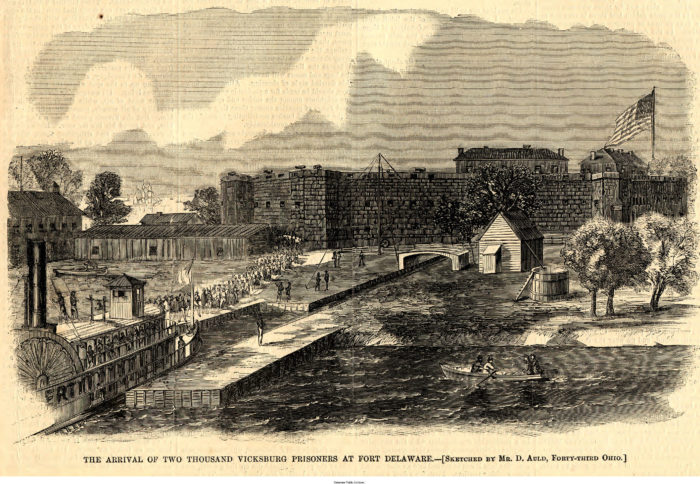
We were marched through Fredericksburg, camping one night in a drenching rain without protection of any kind to Acquia Creek where we took a boat for Point Lookout as prisoners of war – May 14, 1864. Remaining at Pt. Lookout about six weeks, undergoing all sorts of indignities offered the prisoners by Negro troops, ex-slaves who guarded us, we were removed to Fort Delaware in an old transport reaching there about the last of June 1864.
The arrival of 2,000 Vicksburg prisoners at Fort Delaware. Image: Public Domain.
Recollections of prison life at Ft. Delaware can never be blotted from my memory. To the kindness of Southern sympathizers in Baltimore and elsewhere within the Federal lines are many of us indebted for the only comforts we had. We were both clothed and fed by these good people. The scanty and unwholesome allowances of rations – wormeaten beans, tough beef and half risen hard bread – were barely sufficient to sustain life. I feel and hope that all of my children will ever feel a debt of deepest gratitude to Mrs. Ann Eliza Bestor and Miss Alice Kay Howard of Baltimore for their kindness to me in furnishing clothing, books and writing material, without which I could not have lived.
Lee Surrenders
We had many experiences at Ft. Delaware. The assassination of President Lincoln was particularly exciting. We were not allowed by the officers in command of us to gather in groups even to discuss the affair outside our barracks. For any violation of this order the guard was ordered to fire upon us. Such was the feeling against the South and Southerners. Then again the surrender of Gen. Lee, while a source of rejoicing to the Yankees, was a bitter morsel to us. Many of us hoped for the final success of our cause but there were alternating fears as to the result.
Return to Civilian Life
After fully realizing the fact that Gen. Lee had surrendered and our cause had been lost, a few of our imprisoned officers declared that they would never take the oath of allegiance to the U. S. Government, the only condition of our release from captivity, but the larger number complied with the proposed terms and in the first part of June of 1865 the administration of the oath began in alphabetical order reaching me June 16, 1865. I was furnished transportation to Danville, Virginia, spent one day in Baltimore visiting some of the friends who had so generously contributed to my wants while in prison, came to Richmond, spent one night, boarded a train for Danville in the morning, reaching News Ferry the same evening.
After greetings with my old friends in Halifax, I went to visit my aunt and sisters near Leaksville, remaining with them until about the first of August when I returned to News Ferry and engaged in business with Jennings & Edmunds. Notwithstanding the desolation of the whole country, the scarcity of money and everything which go to contribute to the comfort of life there was a spirit of general pleasure and happiness that the “war was over.” And every man went to work with determination, hiring their former slaves who would remain with them, giving them shares in the crop which in nearly every case was as satisfactory as could be expected.
Elizabeth Caldwell Oliver
7 Nov 1848 – 14 Feb 1927
I began to feel that the one thing I needed most of all others was a wife. It was right hard for me to decide in my mind who I would ask to share with me what there might be in future for me, until I incidentally had the pleasure of meeting my present dear wife in the store at News Ferry who had come there to make some few purchases.
Her bright face, sparkling eyes and perfect figure most tastefully adorned thrilled me with admiration. “Can I,” I thought, “gain favor with her?” The die was cast; I had seen the woman of women and was not long in determining upon my course. She continually haunted me. At the same time, I was as shy as a girl of sixteen. I dreaded to see or hear of any and every young man who knew and visited her. My opportunity came at last. I asked her to marry me – she said yes. A fresh impulse seized me. I thought thus – you hold me in as high favor as any other may be and right earnestly did I pay her such attention that on December 19th, 1866 it culminated in the marriage of your Papa and Mama.
The video above is an AI animation from a photograph of Elizabeth Caldwell Raine. Video: Myheritage.com.
Entrepreneur
After this happy event in my life, everything was sunshine and happiness for a year. Although poor and without a dollar I had health and a plenty of energy and push, and lived with my wife’s parents while carrying on the mercantile business at Bloomsburg. I forgot to mention the fact that in August 1866 I was taken into business with Polk Jennings assuming Mr. Thomas Edmunds’ liabilities with Jennings & Edmunds, the firm being afterwards Jennings & Raine.
After my marriage Jennings and I dissolved, dividing the stock of goods, he remaining at News Ferry and I taking mine to Bloomsburg and going in with Mr. Oliver. This was not a profitable venture, we lost money and did not see that we could successfully operate at Bloomsburg longer and after one year we closed out and I commenced farming on the lands of Mr. Oliver. As a farmer I succeeded better made something but lived hard. Not being brought up as a farmer, I grew dissatisfied realizing that it was time I was accumulating something for my family, so in January 1871 I went to Mt. Airy, N. C. and worked as bookkeeper and clerk in the store of J. M. Brower & Bro. at $50 per month or $2 per day. I saved my money, saved every dollar that I was not compelled to spend. In May 1871, I took my wife and two children Willie and Johnnie to Mt. Airy with me, they having remained in Halifax until that time. I became dissatisfied in Mt. Airy after a few months as well as my wife, there being no society for us and no inducement for us to remain there and bring up our little boys.
Move to Danville and Success
General View From Across the Dan, Harper’s Weekly, Jan. 29, 1887. Author image.
I came to Danville in 1871 and engaged in business with Hickson & Tyack until March 1, 1874, when J. M. Brower started me in the manufacture of tobacco, giving me 1/3 net profits, the firm being C. A. Raine & Co. We continued in business under many difficulties and without success until 1878 when Mr. Brower sold out lock, stock and barrel. After, Holmes & Company, Cincinnati, furnished the means with which to buy and I took the business in hand with H. Holmes & Company as my backers and handling all the tobacco I manufactured; in a few years I was independent and became one of the successful manufacturers of Danville. I continued with unabated success until 1892 when on account of physical weakness I sold 2/3 of my business to Lyons & Wilson. In 1893, July 19, I came very near dying with hemorrhage from my lungs after which I was totally incapacitated for any kind of business and Mr. George N. Wilson assumed the whole management of affairs.
And Back Full Circle
In November 1895, C. A. Raine & Company made an assignment. Every dollar, every piece of property I had accumulated by long, hard and persistent efforts were taken away for the debts of the firm.
Final Admonishment
My dear children, you all know the rest and in closing this simple sketch which is intended only for you I will just add a few words of parental admonition. All that I have ever made in the good things of this world I do not know of one dollar’s worth that I dishonestly gained. I have never willfully and knowing wronged, cheated or defrauded my fellow man in any sort of business transaction and you must not feel that my troubles have some upon me as a punishment but take my view of it: that God has afflicted me for my good, that they are blessings in disguise and that in due time it will be manifest to us all. Live as I have tried to live. Whenever you can, relieve those you see struggling in poverty and do not turn a deaf ear to the appeal of anyone in adversity. Do not bear any ill will towards those who have brought me to suffer and struggle to live. But, take warning by my experience and never have a partner in any business until you have studied well the character and past life of those with whom you contemplate associating yourself and then in business transactions act strictly upon business principles. Let your aim be free from
Note: This lightly-edited version and the section headings are from Syd Dickenson’s Raine family history website. The headings did not appear in the original manuscript.


 C.A. Raine & Co.